

Billions of dollars have vanished in minutes. Not through traditional hacking, not through insider theft, but through lines of code that were supposed to be immutable, trustless, and secure. Smart contracts promised a financial system without middlemen, one where code replaces courts and logic replaces trust. That promise has held in many ways. But when it breaks, it breaks spectacularly.

The top 10 smart contract security failures that shocked the crypto world are not just cautionary tales. They are a blueprint for understanding where decentralized systems are most vulnerable, why traditional security thinking fails in this space, and what it genuinely takes to protect a protocol at scale. If you are building in Web3, funding a DeFi project, or advising one, these failures are required reading.
1. The DAO Hack (2016): The Attack That Split Ethereum
No list of smart contract security failures is complete without The DAO. In June 2016, an attacker drained 3.6 million ETH, worth approximately $60 million at the time, from a decentralized autonomous organization that had raised what was then the largest crowdfunding in history.
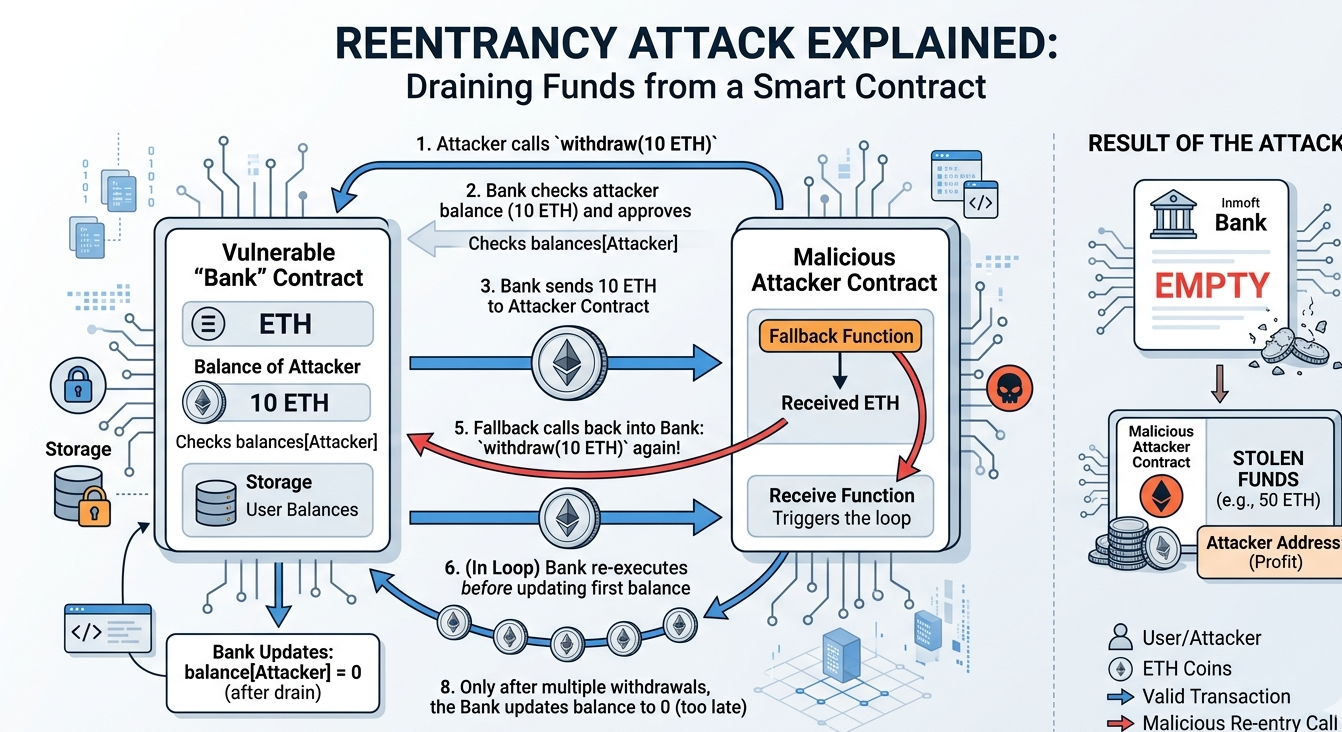
The exploit was a reentrancy attack. The DAO’s withdrawal function sent funds before updating its internal balance. An attacker called the withdrawal function repeatedly within a single transaction, looping it to drain funds before the contract recognized the balance had changed.
The consequences were enormous. Ethereum itself hard-forked to reverse the transactions, creating Ethereum Classic in the process. More importantly, the attack established a foundational truth: a smart contract without thorough security review is a loaded weapon.
2. Parity Wallet Hack (2017): $30 Million Gone Through a Shared Library
Parity’s multi-signature wallet was a widely trusted tool. In July 2017, an attacker found a vulnerability in a shared library contract that the wallet relied upon. The library contained an initialization function that had never been properly secured. The attacker called it, claimed ownership of the library, and then self-destructed it.
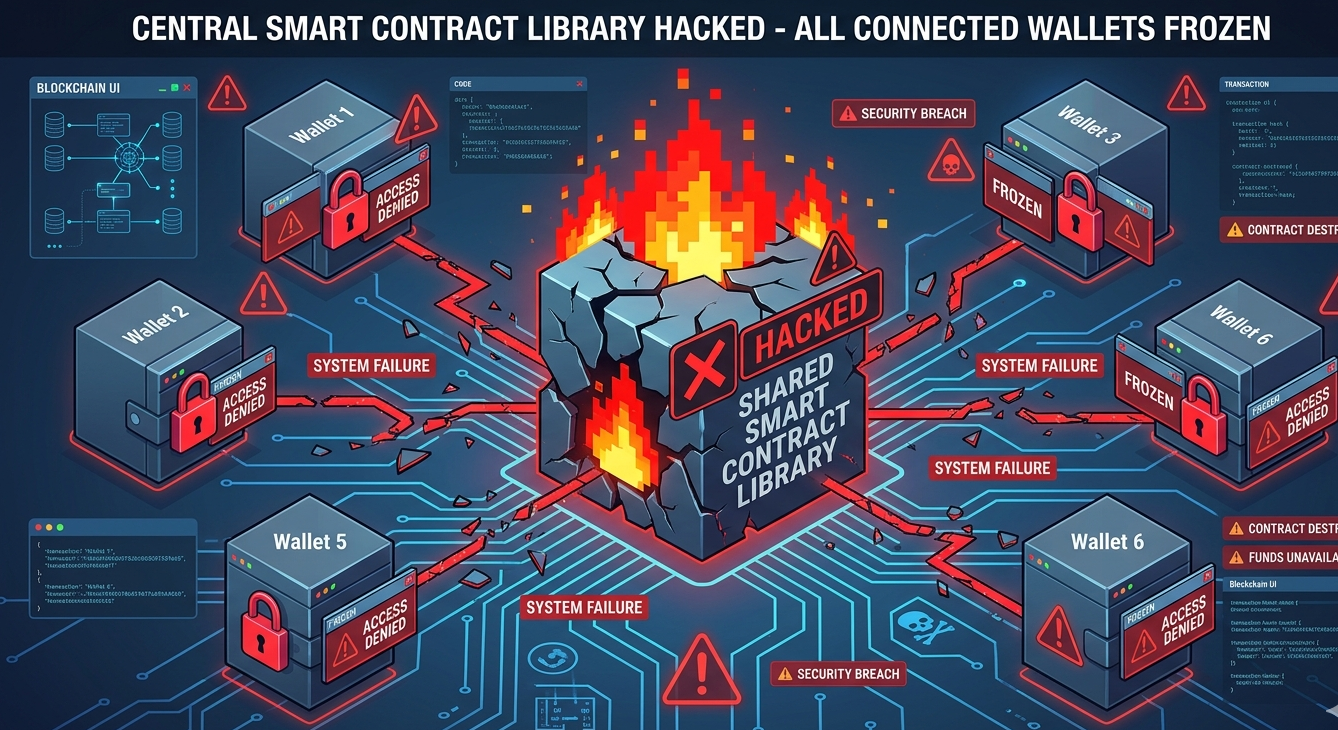
The result: every wallet depending on that library became permanently frozen. Over $30 million in ETH was locked, never to be recovered. A second, separate Parity incident later that year added another $150 million to the damage.
What made this particularly striking was the trust placed in shared infrastructure. The assumption that a library contract is safe because many people use it is one of the most dangerous misconceptions in smart contract development.
3. bZx Flash Loan Attacks (2020): When Speed Becomes a Weapon
Flash loans introduced a novel financial primitive to DeFi: uncollateralized loans that must be borrowed and repaid within a single transaction. Legitimate uses exist. But in February 2020, the bZx protocol learned what happens when this primitive is weaponized.
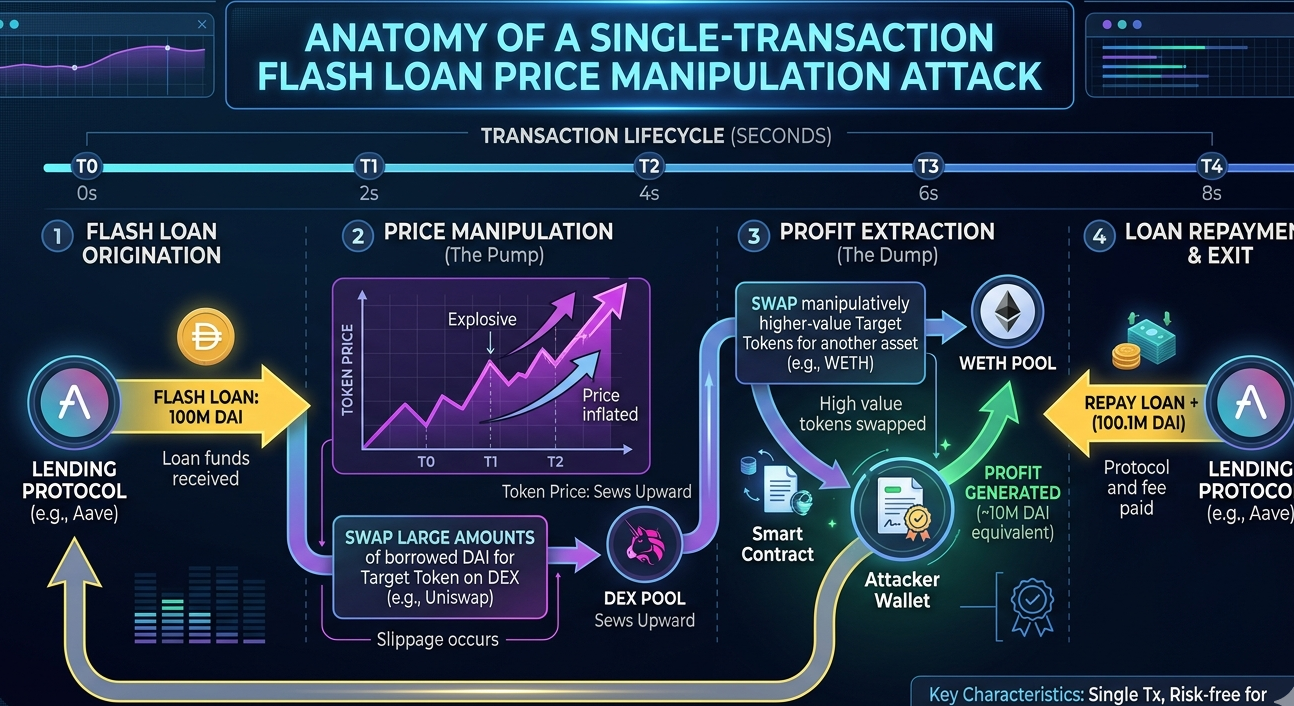
Over two consecutive attacks, a hacker exploited price manipulation vulnerabilities using flash loans. By borrowing large amounts, manipulating oracle prices, and arbitraging the distorted rates, the attacker extracted nearly $1 million in total within days.
The vulnerability was not in any single line of code. It was in the protocol’s reliance on a single price oracle that could be manipulated within one transaction. Flash loan attacks redefined the threat model for DeFi entirely, forcing the industry to reconsider how protocols measure and trust price data.
4. Poly Network (2021): $611 Million and a Strange Apology
In August 2021, Poly Network suffered what became the largest DeFi hack in history at the time. An attacker exploited a vulnerability in the cross-chain messaging logic, specifically a flaw that allowed them to bypass privilege checks and call a function reserved for contract administrators.

The attacker drained $611 million across Ethereum, Binance Smart Chain, and Polygon simultaneously.
What followed was unusual. The attacker returned the funds, claiming it was done to “expose the vulnerability.” Poly Network eventually offered them a bug bounty and, in a surreal turn, called them “Mr. White Hat.” Whether that framing was deserved remains debated. What is not debated is the severity of the flaw itself: a cross-chain bridge with admin privilege logic that could be bypassed entirely.
5. Compound Finance (2021): A Bug in an Upgrade, Not an Attack
Not every catastrophic smart contract failure involves a malicious actor. Compound Finance’s September 2021 incident is a reminder that governance proposals and contract upgrades carry risk that is just as real as external attacks.
A governance proposal introduced a bug into the protocol’s reward distribution logic. Instead of distributing COMP tokens according to the intended formula, the upgraded contract began distributing them at a dramatically higher rate. Approximately $80 million in COMP tokens were over-distributed before the error was caught.
The protocol could not simply pause and fix it. Smart contracts, by design, are difficult to modify once deployed. A second governance proposal was required to patch the bug, and even that process took days to pass through the decentralized governance structure.
This case illustrates something the industry often overlooks: post-deployment vulnerabilities introduced through updates can be just as devastating as any pre-deployment flaw. Continuous monitoring of protocol behavior after governance changes is not optional. It is a necessity.
6. Ronin Network (2022): $625 Million Lost to Validator Compromise
Axie Infinity’s Ronin sidechain suffered the largest crypto hack ever recorded in March 2022. Attackers gained control of five out of nine validator private keys, enough to authorize withdrawals from the bridge. They then drained 173,600 ETH and 25.5 million USDC, totaling $625 million.

The breach was not purely a smart contract vulnerability in the traditional sense. It combined social engineering, compromised keys, and an exploitable threshold in the multisig setup. The network did not even detect the breach for six days, discovered only when a user reported they could not withdraw funds.
What made Ronin particularly alarming is how it exposed the soft underbelly of many blockchain bridges. The on-chain logic may be secure, but if the off-chain validator infrastructure can be compromised, the entire system falls. Security cannot end at the contract boundary.
7. Wormhole Bridge (2022): $320 Million and a Forged Signature
In February 2022, the Wormhole cross-chain bridge was exploited for 120,000 wrapped ETH, worth approximately $320 million. The attacker discovered that the bridge’s Solana-side code had a flaw in how it verified guardian signatures.

Specifically, the code used a deprecated function that could be bypassed to create forged verification data. The attacker minted 120,000 wETH on Solana without providing the required ETH collateral on Ethereum’s side.
This attack is a case study in what happens when deprecated code paths linger in production contracts. The fix existed. The safer function was available. But the older, insecure method had not been removed, and that gap cost $320 million.
Jump Crypto, Wormhole’s backer, covered the loss. Most protocols do not have that safety net.
8. Nomad Bridge (2022): The Chaotic Free-for-All
July 2022 brought one of the strangest hacks in crypto history. Nomad Bridge suffered a $190 million exploit, but unlike most attacks, this one required almost no technical sophistication after the initial discovery.
A routine upgrade introduced a misconfiguration into the contract’s message verification logic. Because of this error, any message could be processed as valid. Once the first attacker found and exploited this, the transaction was visible on-chain. Hundreds of opportunistic participants simply copied the exploit transaction, changed the recipient address to their own, and submitted it themselves.
It was, in effect, a permissionless money printer for a brief window. No sophisticated tooling, no complex exploit chain. Just copy, paste, and collect. The damage was $190 million.
The lesson here is uncomfortable: a single misconfigured parameter in a bridge contract can make it trivially drainable by anyone who notices.
9. Euler Finance (2023): $197 Million and a Near-Perfect Storm
Euler Finance’s March 2023 attack was technically sophisticated. The attacker exploited a combination of vulnerabilities: a missing health check in a specific function, a donation mechanism that inflated the protocol’s internal accounting, and flash loans used to amplify the imbalance.
By creating a “donator” and “liquidator” contract that interacted in a coordinated sequence, the attacker manufactured an artificial state where a liquidation yielded more collateral than should have been possible. $197 million was extracted.
In a notable turn, the attacker returned the funds weeks later after Euler initiated communication. But the return of funds does not diminish the significance of the vulnerability itself. The exploit worked precisely because of an interaction between multiple protocol features that individually seemed safe.
This highlights a mature insight about smart contract security: it is not enough to audit individual functions. Interactions between functions, especially when combined with flash loan leverage, can create emergent vulnerabilities that no single-function review would catch. Tools that analyze multi-step interaction patterns, like what a smart contract auditor using Solidity Shield examines during a deep-dive audit, can surface these cross-function risks before deployment.
10. Curve Finance (2023): Compiler-Level Vulnerability
In July 2023, Curve Finance suffered a series of pool exploits totaling over $70 million. The cause was not a flaw in Curve’s Solidity code. It was a vulnerability in Vyper, the alternative smart contract programming language Curve used, specifically in compiler versions 0.2.15, 0.2.16, and 0.3.0.
These versions had a broken reentrancy guard implementation. The compiler was not generating the correct bytecode to enforce the lock. Despite the code appearing to protect against reentrancy at the source level, the compiled output did not.
This is perhaps the most unsettling entry on this list. Even carefully written code, by experienced developers, on a mature and widely-used protocol, can be vulnerable if the underlying toolchain is compromised or flawed. It forces a reckoning with the full stack of trust in smart contract development.
The Pattern Behind the Failures
Looking across these ten incidents, a clear pattern emerges. The vulnerabilities fell into recognizable categories: reentrancy, logic errors in upgrade paths, oracle manipulation, cross-chain messaging flaws, and compromised off-chain infrastructure. None of these are exotic. All of them were known risks at the time.
So why did they persist? Because smart contract security is not a one-time checkbox. A pre-deployment audit, while critical, is a snapshot of code at a single moment. The threat landscape evolves. Protocol upgrades introduce new risk surfaces. Market conditions create new attack incentives. And the composability of DeFi means that a vulnerability in one protocol can cascade into another.
The industry’s response to this has been maturing. Protocols are increasingly combining pre-deployment audits with runtime monitoring, behavioral anomaly detection, and automated mitigation mechanisms. The idea that a deployed contract is safe because it was audited is a belief that these ten failures have thoroughly dismantled.
Real security in Web3 requires looking at the protocol continuously, not just before launch. This is why platforms like SecureDApp have developed products oriented around both pre-deployment review and post-deployment vigilance. Solidity Shield, their smart contract auditing tool, is built to catch vulnerability patterns at the code level before anything goes live. SecureWatch extends that coverage after deployment, detecting anomalous on-chain behavior in real time and providing an automated mitigation mechanism called AutoPause, which can halt suspicious activity mid-threat. Whether a team uses these tools or builds an equivalent internal capability, the point is that the approach itself matters: security cannot stop at audit completion.
What Effective Smart Contract Security Actually Looks Like
Every failure on this list could have been prevented or meaningfully mitigated. That is not hindsight bias. It is a reflection of how preventable most of these vulnerabilities were with the right process.

Effective smart contract security combines several layers. It starts with rigorous pre-deployment auditing, not just automated scanning but manual review of logic, interaction patterns, and edge cases. And continues through staged deployment, where new contracts go live in limited environments before full exposure. It includes ongoing monitoring after deployment, because code behavior in production can differ from test conditions, especially under adversarial pressure.
Incident response planning matters too. The Nomad and Ronin incidents both revealed significant delays between the breach and detection. A protocol that can detect an exploit in minutes and respond automatically has a fundamentally different risk profile than one that discovers a breach six days later through a user complaint.
Finally, governance security deserves more attention than it currently receives. Compound’s 2021 incident was not an external hack. It was a governance-approved upgrade with a bug. Any security framework that does not include review of governance proposals before they go live has a significant blind spot.
Conclusion
The top 10 smart contract security failures that shocked the crypto world are not simply cautionary tales from a young and reckless industry. They are data points in an ongoing education about what it takes to build secure, resilient decentralized systems at scale.
The amounts lost, over $2 billion across these ten incidents alone, are significant. But the more important metric is what the industry learned from each one. Reentrancy guards became standard. Flash loan-resistant oracle designs emerged. Cross-chain bridge architectures are being rethought. Each failure advanced the field in ways that no research paper could have.
What remains insufficient is the gap between what the industry knows and what individual teams actually implement. Many protocols still treat auditing as a final step before launch rather than one component of a continuous security program. Many still deploy without monitoring. Most still have no incident response plan.
The question is not whether smart contracts can be secure. They can. The question is whether the teams building them will invest in security with the same seriousness that attackers invest in finding weaknesses. Given what is at stake, the answer has to be yes.
Frequently Asked Questions
1. What is a smart contract security failure?
A smart contract security failure occurs when vulnerabilities in deployed blockchain code are exploited, typically resulting in financial losses. These failures can stem from coding errors, logic flaws, or design weaknesses in the contract itself.
2. What is a reentrancy attack in smart contracts?
A reentrancy attack happens when an attacker calls a function repeatedly before the contract updates its state. The DAO hack is the most famous example. The attacker exploited a withdrawal function that sent funds before recording the change in balance.
3. How do flash loan attacks work?
Flash loans allow users to borrow large amounts of cryptocurrency without collateral, provided they repay within the same transaction. Attackers use these loans to manipulate prices, exploit arbitrage gaps, or destabilize protocols for profit.
4. Are audited smart contracts completely safe?
No. An audit provides a snapshot of code security at a specific point in time. Vulnerabilities can be introduced through upgrades, newly discovered attack vectors, or interactions between multiple contracts. Ongoing monitoring is essential.
5. What makes cross-chain bridges particularly vulnerable?
Bridges involve complex logic across multiple blockchains and often rely on off-chain validator infrastructure. This creates multiple attack surfaces, including the smart contract logic, the validator key management, and the message verification systems.