

The transaction looked normal. A few lines of on-chain activity, a handful of function calls, and then it was over. Within minutes, a protocol that had taken months to build had been drained of tens of millions of dollars. No alarms had triggered. No one had noticed until the damage was done.

This is not a hypothetical. It is a pattern that has repeated itself across the blockchain ecosystem more times than anyone in the industry is comfortable admitting. And every time it happens, the post-mortem points to the same uncomfortable truth: the vulnerability was there before the first user ever interacted with the protocol.
How smart contract security failures lead to million-dollar losses is not a mystery. The mechanics are well-documented, the patterns are recognizable, and in nearly every case, the loss was preventable. What is missing, more often than not, is not talent or intention. It is a structured understanding of where things go wrong and why the stakes are so uniquely high in this environment.
That is exactly what this guide addresses.
Why Smart Contract Failures Hit Differently Than Traditional Software Bugs
Every software system has bugs. In most cases, bugs are discovered, patched, and deployed as updates. Users experience a degraded service temporarily, but the damage is contained. The system recovers.
Smart contracts do not work that way.
When a smart contract is deployed to a public blockchain, it becomes immutable. The code is fixed. There is no patch mechanism unless one was explicitly built in from the start, and even upgradeable contracts introduce their own category of risk. This means a vulnerability discovered after deployment cannot simply be removed. It exists for as long as the contract exists, and the contract exists forever.
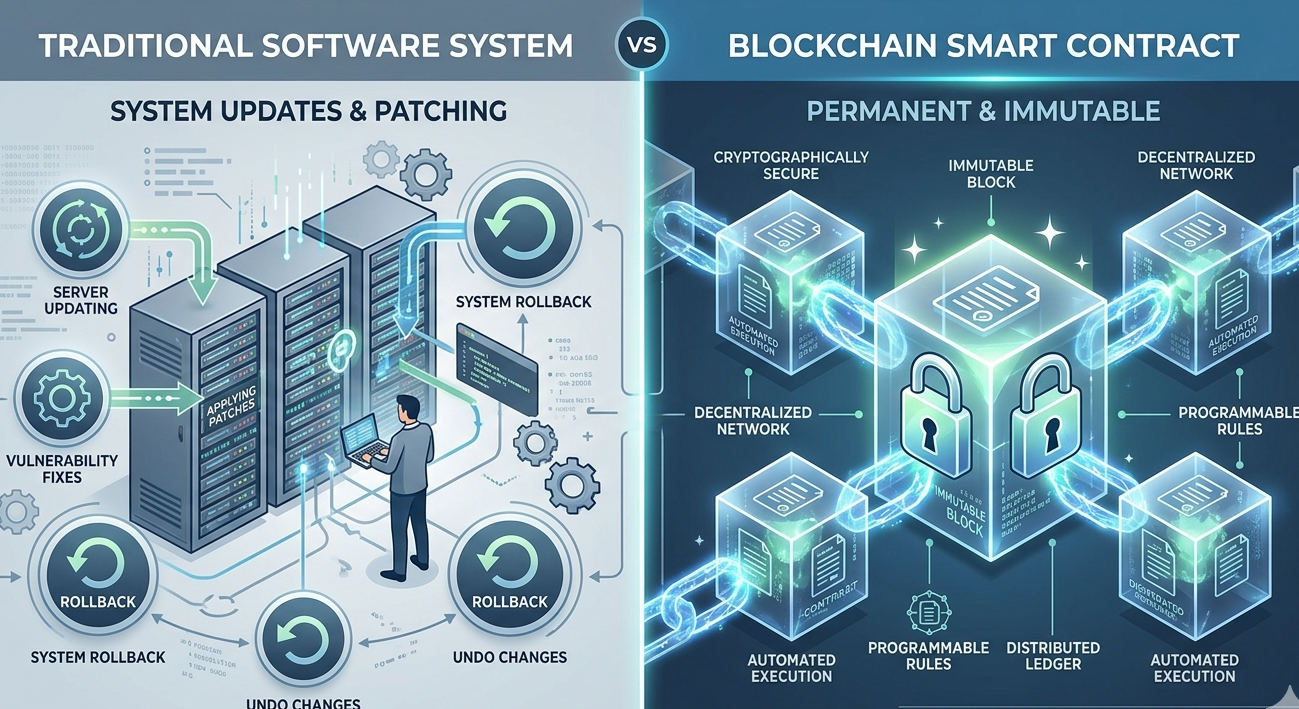
The transparency of public blockchains compounds this problem in a way that most developers do not immediately appreciate. Your contract’s bytecode is visible to everyone. Attackers do not need to guess what your contract does. They can read it, decompile it, simulate it, and identify exploitable paths with precision. The information asymmetry that traditional security sometimes relies on does not exist here.
Add financial value into that equation and the picture becomes stark. Smart contracts routinely hold millions, sometimes billions, of dollars in assets. They are the custody mechanism, the logic layer, and the settlement infrastructure all at once. When the logic fails, the value flows out. There is no chargeback, no fraud department to call, and no regulator who can claw it back.
This is why smart contract security failures lead to million-dollar losses. The architecture of blockchain removes every buffer that traditional systems rely on.
The Scale of the Problem: What the Numbers Actually Show
It is easy to treat individual exploits as isolated events, bad luck or exceptional circumstances. The data tells a different story.
According to on-chain security research, over $3.8 billion was lost to smart contract exploits in 2022 alone. The following year remained brutal, with losses across DeFi protocols exceeding $1.8 billion. These numbers include exploits across Ethereum, BNB Chain, Solana, and various Layer 2 ecosystems. The losses span every category of protocol: lending platforms, decentralized exchanges, cross-chain bridges, yield aggregators, and NFT marketplaces.
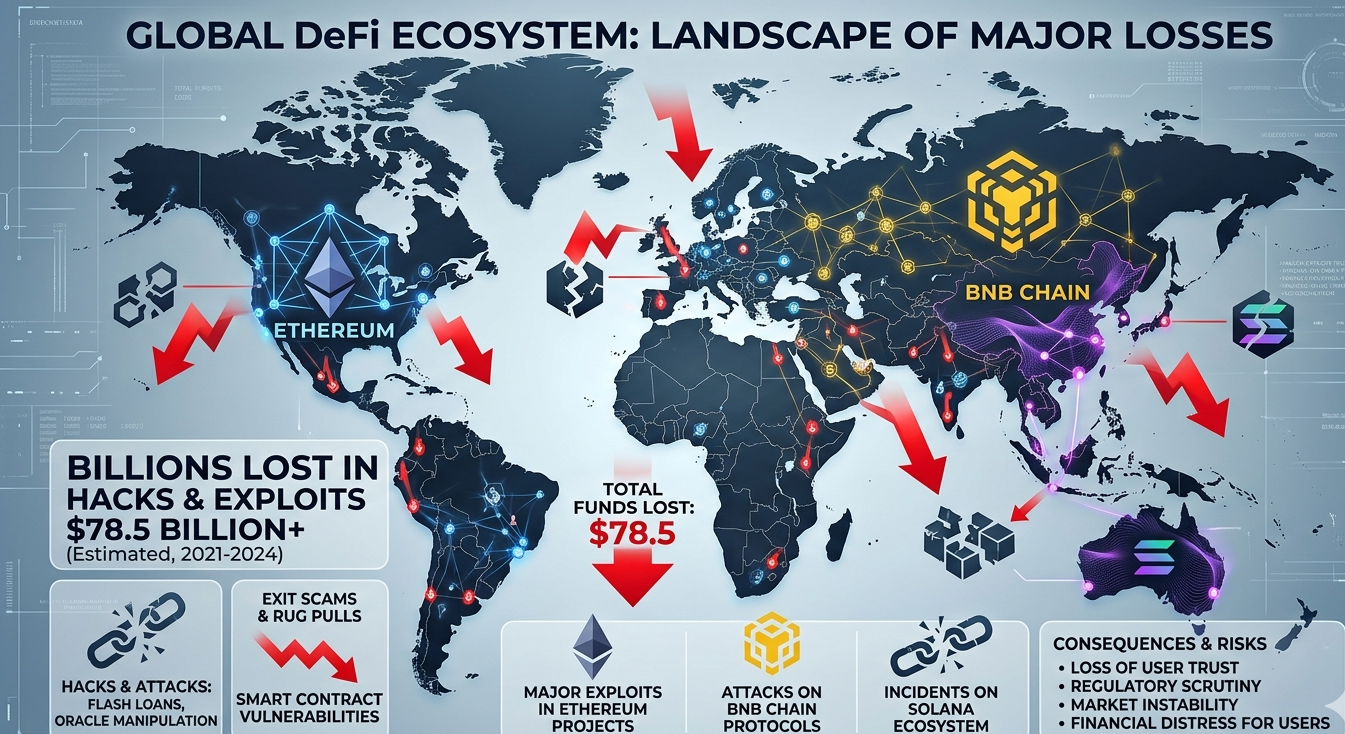
What is particularly striking is the distribution of causes. Flash loan attacks, reentrancy exploits, access control failures, and oracle manipulation collectively account for the vast majority of losses. These are not exotic zero-day vulnerabilities discovered through years of sophisticated research. They are well-understood, documented vulnerability classes that appear in security literature, audit guidelines, and developer education resources.
The conclusion is difficult to escape: most of these losses were not inevitable. They resulted from code that was deployed without adequate security review, tested only for correct behavior rather than adversarial behavior, or built by teams that did not yet have a structured understanding of the threat landscape they were entering.
Case Study: When Reentrancy Drains Everything
The reentrancy vulnerability is older than most of the developers currently building in Web3. It became infamous in 2016 when an attacker exploited it in The DAO, a decentralized investment fund on Ethereum, and extracted approximately $60 million worth of ETH. The event was significant enough to split the Ethereum community and produce the fork that gave us Ethereum Classic.
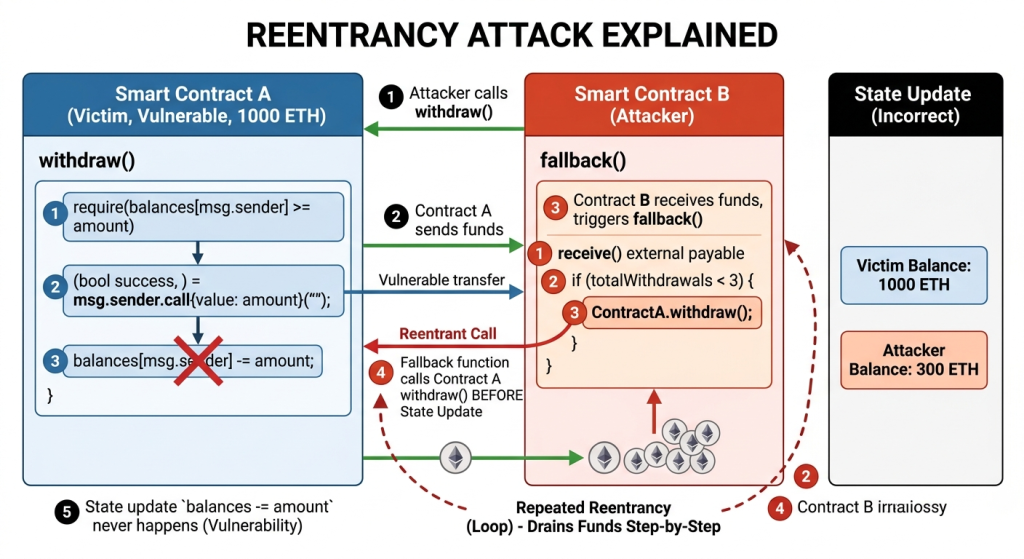
The mechanics are deceptively simple. A smart contract sends ETH to an external address as part of a withdrawal function. Before the contract updates its internal balance to reflect that withdrawal, the external address, in this case a malicious contract, calls back into the withdrawal function. The balance check passes again because the state has not yet been updated. The malicious contract withdraws again. And again. In a loop, until the vault is empty.
The fix has been known for nearly a decade. Update state before making external calls. Apply a reentrancy guard. Follow the Checks-Effects-Interactions pattern without exception.
And yet reentrancy exploits continued to appear years after The DAO. In 2020, Uniswap and Lendf.me were hit in a coordinated attack involving ERC-777 token callbacks that reintroduced reentrancy conditions. In 2022, a variation contributed to losses at a major cross-chain bridge. The pattern keeps appearing because developers who were not there for the original lesson keep making the original mistake.
The cost of not understanding reentrancy is not abstract. It is counted in millions.
Case Study: Access Control Failures and the Open Door Problem
If reentrancy is the most historically significant vulnerability, access control failures are arguably the most common cause of catastrophic loss today. They also tend to generate the most frustration in post-mortems, because the errors are often so straightforward.

Consider what happened to Ronin Network in March 2022. The cross-chain bridge used by the Axie Infinity game was exploited for approximately $625 million in ETH and USDC, making it one of the largest crypto thefts in history. The root cause was not a sophisticated cryptographic attack. The attacker gained control of five out of nine validator private keys, enough to authorize withdrawals. The access control architecture had a centralization flaw that was not adequately recognized or protected.
At the smart contract level, access control failures often look simpler. An initialize() function that can be called by anyone after deployment. An admin function missing its modifier. A role that was defined but never assigned, leaving a critical function permanently unprotected or permanently locked. A privileged address hardcoded to a development wallet that was never rotated.
In the Parity multisig wallet exploit of 2017, a developer accidentally triggered a function that was supposed to be protected, converting a shared library contract into a personal wallet and then locking it. The result was approximately $150 million in ETH frozen permanently, inaccessible to anyone.
These are not theoretical scenarios. They are the documented, verified consequences of insufficient access control. And they continue to happen because access control is treated as a checklist item rather than a design discipline.
Case Study: Oracle Manipulation and the Price Feed Problem
Decentralized finance protocols frequently need to know the price of assets. They use this information to determine collateralization ratios, trigger liquidations, calculate swap rates, and distribute rewards. The source of this price information is a price oracle, and oracles are one of the most persistently exploited surfaces in DeFi.
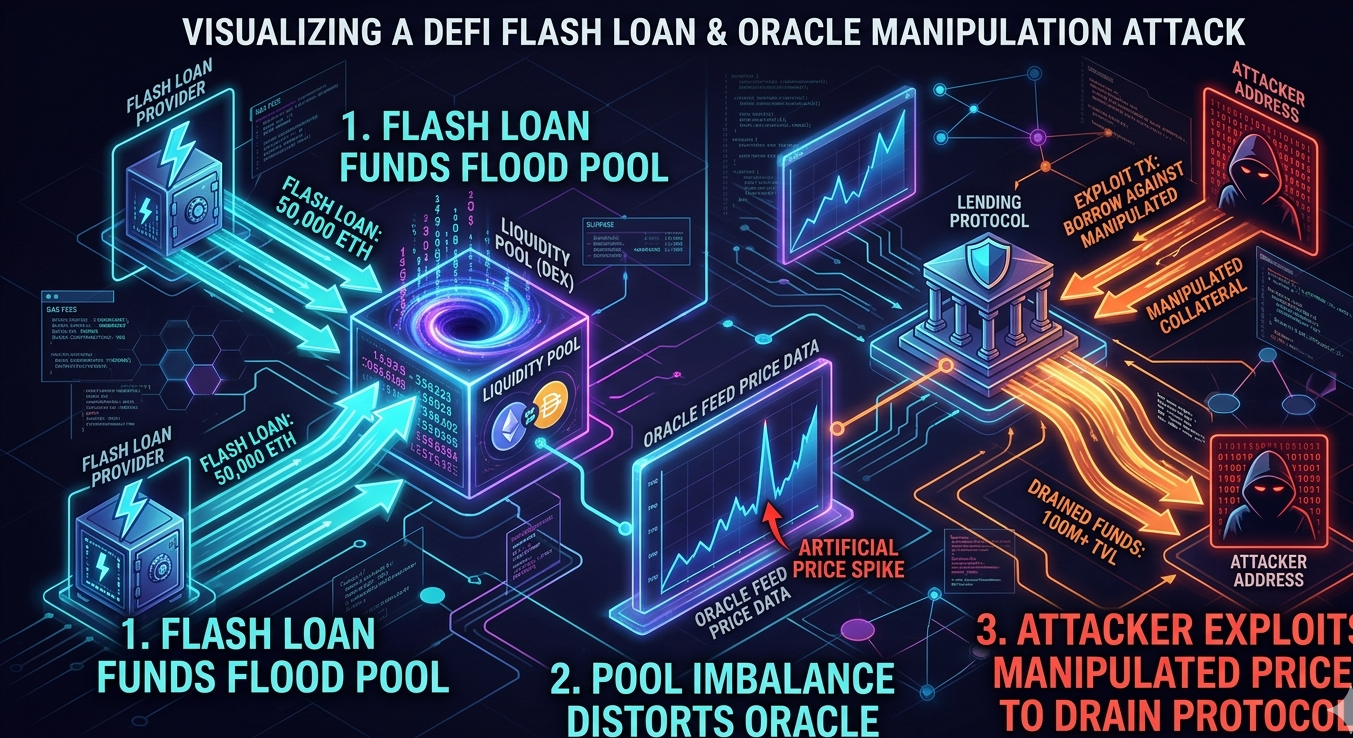
The core vulnerability is this: if your protocol reads price from a source that can be temporarily manipulated, an attacker can distort that price, exploit the resulting mispricing, and profit, all within a single transaction.
Flash loans made oracle manipulation dramatically more accessible. Before flash loans, manipulating a price feed required owning large amounts of capital. After flash loans, any attacker with the technical knowledge could borrow $50 million worth of tokens, move a price feed significantly, exploit a protocol that relied on that feed, and repay the loan, all in one atomic transaction.
The Harvest Finance exploit in October 2020 followed this pattern closely. An attacker used flash loans to repeatedly manipulate the USDC price in a Curve pool, exploited Harvest’s reliance on that pool for pricing, and extracted approximately $34 million before repaying the loan. The entire operation took seven minutes.
Mango Markets was hit for over $100 million in October 2022 through a similar mechanism, where the attacker manipulated the price of the MNGO token using their own funds to inflate it, then borrowed against that inflated collateral value and drained the treasury.
The lesson for developers is clear: on-chain spot prices from DEX pools are manipulable within the scope of a single transaction. Protocols that depend on them for critical decisions are vulnerable. The solution involves using time-weighted average prices, decentralized oracle networks with multiple data sources, or circuit breakers that reject prices deviating significantly from recent ranges.
Case Study: Logic Flaws and the Invisible Vulnerability
Not every catastrophic exploit results from a vulnerability that shows up in a static analysis scan. Some of the most damaging losses come from logic flaws: code that compiles without warnings, passes its tests, and functions exactly as written, but does not function as intended.
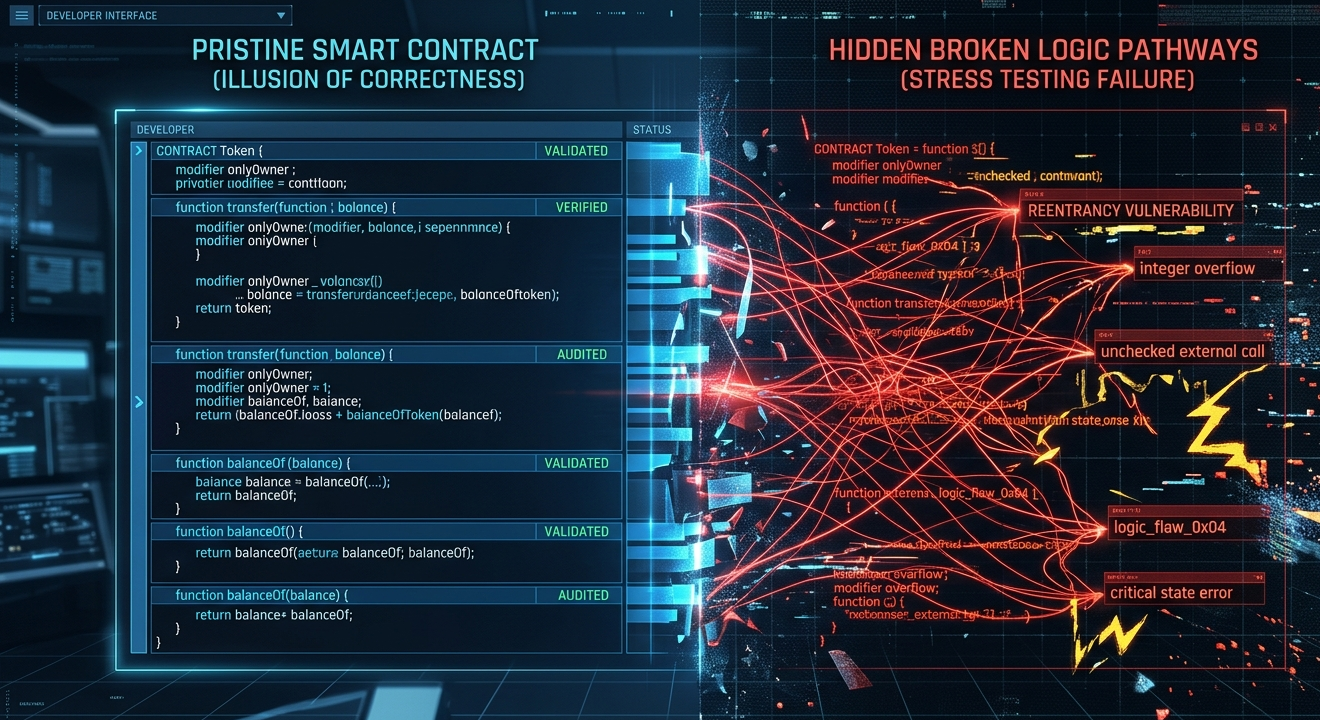
Logic flaws are the hardest category to catch because they require understanding what the code is supposed to do. A tool can tell you that a function lacks a reentrancy guard. It cannot tell you that your reward distribution formula allows users to claim more than their proportional share by exploiting rounding behavior across multiple small transactions.
The Beanstalk exploit in April 2022 resulted in a $182 million loss. The attacker used a flash loan to acquire a majority stake in the protocol’s governance token, passed a malicious governance proposal in the same transaction, and executed it before any human could respond. The vulnerability was not a broken function. It was a logical gap in the governance design that did not account for the possibility of flash-loan-funded voting.
This is the nature of logic vulnerabilities. They emerge from interactions between features that individually appear correct. They require adversarial thinking to surface, and adversarial thinking is not something any automated tool can fully replicate.
For teams building complex protocols, logic review must be a deliberate process. It means writing down the invariants your protocol is supposed to maintain, then systematically trying to violate them. It means bringing in reviewers who have no context about how the system was designed and asking them to break it.
The Compounding Effect: Why One Vulnerability Rarely Travels Alone
Post-mortems of major exploits frequently reveal something that is easy to miss when focusing on the primary attack vector: the final loss was usually the result of multiple vulnerabilities or design choices interacting together.
A reentrancy vulnerability only becomes catastrophic when it exists in a function that also lacks proper state management. An oracle manipulation attack only succeeds when it meets a protocol that lacks price deviation checks. An access control flaw only leads to total protocol compromise when there is no time-lock or multisig standing between a privileged call and an irreversible outcome.
This compounding effect means that defense in depth is not optional for smart contract security. Relying on any single protective measure creates exposure at every other layer. A contract protected only by an audit is vulnerable during runtime. A contract with runtime monitoring but no pre-deployment review is vulnerable before it reaches the monitoring system. A contract with good code but poor governance design can be drained through a vote.
Notably, this is also why the relationship between pre-deployment security and post-deployment monitoring is not sequential, as in one replacing the other. It is layered. Both are necessary, and their value increases when they are applied together.
What Inadequate Testing Actually Looks Like
Most developers test their contracts. The problem is the kind of testing that tends to happen in practice versus the kind that would actually catch security vulnerabilities.
Standard unit testing verifies that a function returns the right output for a given input. It checks the happy path. It confirms that the contract behaves correctly when called as intended.
It does not check what happens when a malicious contract is the caller. It does not check whether a function can be exploited by being called in an unexpected order. It does not explore what happens at the edges of valid input ranges, where rounding errors and unexpected behavior tend to emerge.
Security testing requires a fundamentally different posture. It asks not whether the contract works but whether it can be broken. It includes adversarial test cases written with the explicit goal of finding failures. It uses fuzz testing to explore the input space beyond what a developer would write manually. It tests invariants: properties that must hold true under all conditions, regardless of call sequence.
Teams that test only for correctness and then deploy to mainnet are not just taking a risk. They are actively creating the conditions that how smart contract security failures lead to million-dollar losses. The gap between correctness testing and security testing is precisely where attackers operate.
How Pre-Deployment Tooling Reduces Exposure
Manual security review is essential and irreplaceable. It is also time-consuming, expensive, and dependent on the specific expertise of whoever is reviewing. For development teams who need a faster, more systematic first pass across their codebase, automated auditing tools provide significant value.
Solidity Shield, developed by SecureDApp, is built specifically for smart contract vulnerability detection before deployment. It scans Solidity codebases for known vulnerability patterns, flags issues across categories like reentrancy, access control misconfigurations, integer handling risks, and unchecked external calls, and gives development teams a structured view of their security posture before they engage with external auditors.
The practical value here is not that Solidity Shield replaces expert review. It does not, and any honest description of automated tooling will acknowledge that limitation. The value is that it surfaces the identifiable issues early, so that manual review can focus on the harder problems: logic flaws, architectural risks, and adversarial scenarios that tools cannot fully model. It shortens the feedback loop between writing vulnerable code and discovering it.
For teams building under time pressure, that feedback loop is where vulnerabilities survive long enough to reach production.
Post-Deployment Risk: The Window That Never Closes
Even a contract that passes rigorous pre-deployment security review and professional auditing faces an ongoing threat once it is live. Exploits have occurred against audited protocols. New attack patterns emerge as the ecosystem evolves. Integrations added after the original audit introduce new surfaces. And the financial value held in a successful protocol grows over time, making it an increasingly attractive target.
This is the reality that makes post-deployment monitoring not a luxury but a necessity for any protocol handling meaningful value. The attack window does not close after deployment. In many ways, it expands.
SecureWatch, SecureDApp’s AI-driven continuous monitoring product, addresses exactly this layer of the security stack. It watches deployed contracts in real time, detects anomalous transaction patterns, and can trigger alerts when behavior deviates from expected norms. Its AutoPause feature can automatically freeze suspicious contract activity during an active threat, creating response time that would otherwise not exist. For protocols where an exploit can drain funds in minutes, that response window is the difference between a close call and a catastrophic loss.
The complete picture is this: pre-deployment rigor through code review, tooling, and auditing reduces the attack surface before it reaches users. Post-deployment monitoring catches what survives and responds to threats that materialize after the fact. Neither layer alone is sufficient. Together, they represent a security posture that reflects the actual risk environment.
Building a Team Culture That Prevents Losses
Technology and process matter enormously. However, the teams that consistently build secure protocols share something beyond their tooling choices or their audit providers. They treat security as a cultural value, not a compliance requirement.
In practical terms, this means security review happens before deployment pressures create shortcuts. It means junior developers are taught to think adversarially from day one rather than discovering vulnerabilities the hard way in production. It means post-mortems of industry exploits are read and discussed internally, not dismissed as someone else’s problem. It means the team asks not only “does this work?” but “how could this be broken?”
This kind of culture does not emerge from a single decision. It is built through repeated choices to prioritize getting it right over getting it done. In an industry where deployment speed is celebrated and protocol launches generate media attention, that choice runs against certain incentives. But the teams that make it consistently are the ones whose protocols are still running years later.
Furthermore, for protocols that reach meaningful scale, third-party security relationships become part of the picture. Ongoing access to security expertise, whether through formal retainers, bug bounty programs, or continuous monitoring partnerships, extends the security layer beyond what any internal team can sustain alone.
Conclusion
The losses are real, the patterns are consistent, and the causes are well understood. How smart contract security failures lead to million-dollar losses is not a complex story. It is a story about vulnerabilities that were not found before deployment, threat models that were not fully considered, and testing regimes that validated correctness without probing for adversarial failure.
The reentrancy exploits, the access control gaps, the oracle manipulation attacks, and the logic flaws reviewed throughout this guide are not warnings about what might happen. They are records of what has happened, repeatedly, to teams that were often technically capable but insufficiently security-focused.
The response to that record is not fear. It is structured preparation. It means writing code with adversarial thinking built in, using automated tooling to surface identifiable vulnerabilities early, engaging professional auditors before deployment, and implementing continuous monitoring after launch. Each of these layers addresses a part of the risk that the others cannot fully cover.
In an ecosystem where code is permanent, value is real, and attackers are sophisticated, the question is never whether security matters. The question is whether you have done enough, before it is tested in the worst possible way.
Build accordingly.
FAQ: Smart Contract Security Failures and Financial Losses
1. What is the most common cause of million-dollar losses in smart contracts? Access control failures and reentrancy vulnerabilities are among the most frequently exploited. Oracle manipulation and logic flaws have also been responsible for some of the largest individual losses.
2. Can a professional audit guarantee that a contract is safe? No. Audits significantly reduce risk and surface many vulnerability classes effectively. However, audits are point-in-time assessments and cannot catch every logic flaw or account for future integrations and ecosystem changes.
3. What is a flash loan attack and why is it so effective? A flash loan allows an attacker to borrow enormous capital within a single transaction, use it to exploit a vulnerability, and repay the loan before the block closes. Its effectiveness lies in removing the capital barrier for large-scale market manipulation.
4. How do oracle manipulation attacks work? Attackers move the price of an asset on an on-chain source, exploit a protocol that reads that price for critical decisions such as collateral valuation, then reverse the manipulation. Protocols using spot prices from single DEX pools are particularly vulnerable.
5. Why are logic vulnerabilities harder to catch than code-level bugs? Logic vulnerabilities require understanding what the code is intended to do. Automated tools detect known patterns in code structure. They cannot model whether the business logic itself creates exploitable conditions when used adversarially.
6. What is the Checks-Effects-Interactions pattern? It is a Solidity coding discipline designed to prevent reentrancy. Validate conditions first, update state second, make external calls last. This ordering ensures that even a re-entering call encounters correct state.
7. How does the immutability of smart contracts increase security risk? In traditional software, vulnerabilities can be patched after discovery. Smart contracts cannot be modified after deployment unless an upgrade mechanism was built in. A vulnerability that reaches production often stays there permanently.
8. Are upgradeable contracts safer because they can be patched? Upgradeable contracts introduce their own risks, including proxy storage collisions, unauthorized upgrades, and initialization vulnerabilities. They offer flexibility but require careful design and strict access control over the upgrade mechanism.
9. What role does testing play in preventing smart contract losses? Comprehensive testing, including adversarial test cases, fuzz testing, and invariant testing, surfaces vulnerabilities before deployment. Most losses result from contracts where testing only covered expected usage rather than adversarial scenarios.
10. Can a protocol be exploited even after passing an audit? Yes. Audits cover the code at a specific point in time. Exploits have occurred against audited protocols due to logic flaws not caught during review, new attack patterns, or vulnerabilities introduced by post-audit changes.
11. What is the difference between a reentrancy guard and the CEI pattern? CEI is an architectural discipline applied while writing code. A reentrancy guard is a mutex modifier that prevents re-entry at runtime. Both address reentrancy risk; using both together provides stronger protection.
12. What makes cross-chain bridges particularly vulnerable? Bridges manage large pools of assets across multiple chains, require complex validator or oracle systems, and have larger attack surfaces than single-chain protocols. Their complexity and value concentration make them high-priority targets.
13. How do front-running attacks relate to smart contract security? Front-running exploits the public visibility of pending transactions. Attackers see a profitable transaction in the mempool and submit a competing transaction with higher gas fees to be processed first, extracting value from the original sender.
14. What is meant by defense in depth for smart contracts? Defense in depth means applying multiple independent security layers: secure code practices, pre-deployment tooling, professional audits, and post-deployment monitoring. No single layer is sufficient; their value compounds when combined.
15. What should a team do immediately after discovering an active exploit? Pause the contract if a pause mechanism exists. Communicate transparently with users and integrators. Engage incident response experts immediately. Preserve all on-chain and off-chain evidence for forensic analysis. Do not deploy unreviewed fixes under pressure.